Why pray for the dead?
Originally published in Catholic Connection, Volume 34, No. 4 (November 2024), under the title “The Faithful Departed.”
This month’s theme, “Faithful Departed,” caught my attention. In November we more often and intently pray for the faithful departed, but there are two senses to “faithful” departed: all the departed members of the pilgrim church and all who are perfect faithful followers of Christ. Some souls might be in both categories, already in heaven, and thus do not need our prayers. Others could have perished (and are in hell); they do not need our prayers either. The souls who do need our prayers are in the intermittent state, purgatory, and still have debts to pay. They include both God’s faithful and nonbelievers. These poor souls need our prayers every day. I wish to reflect on what could lead one into purgatory.
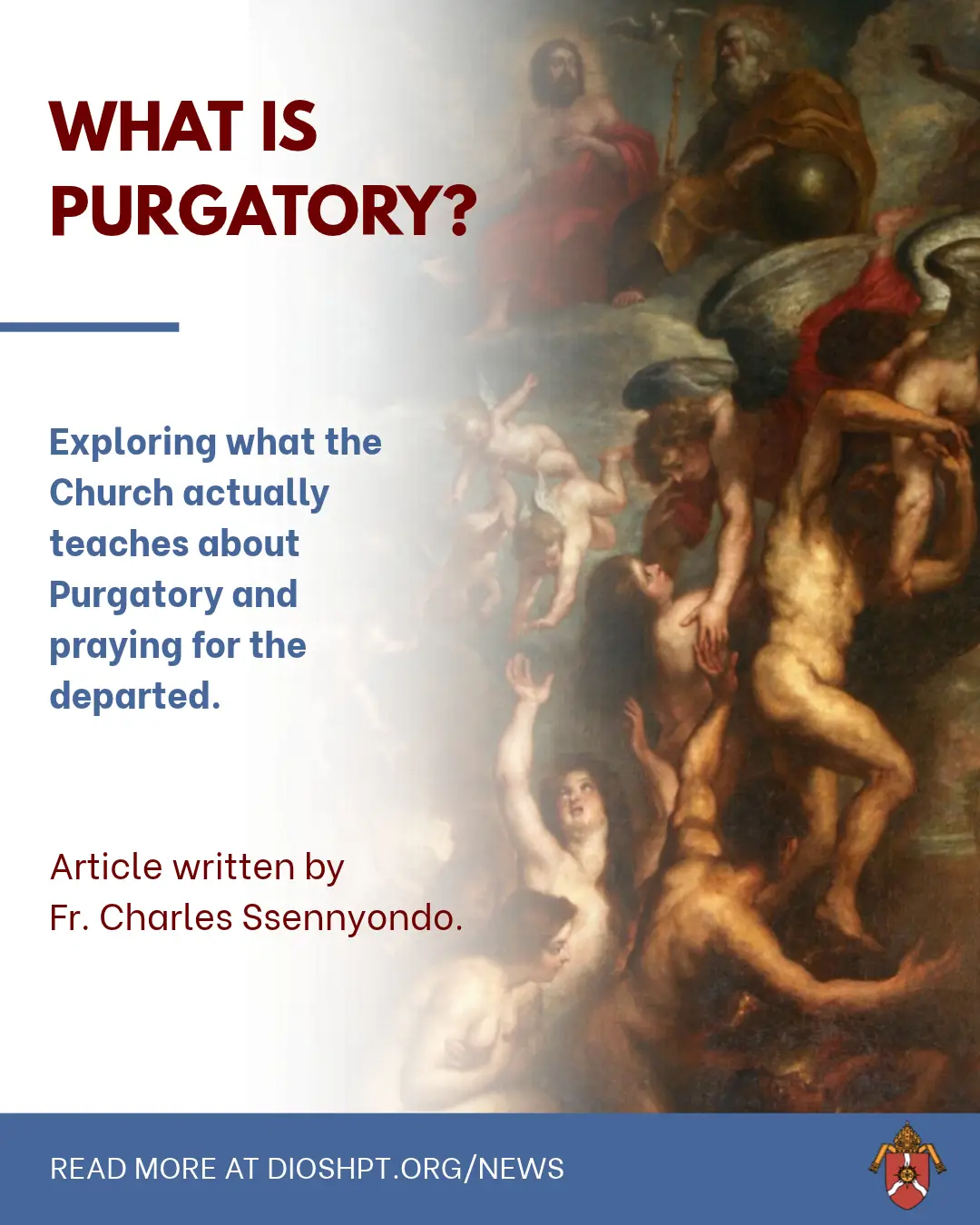
What is Purgatory?
The term purgatory is etymologically derived from a Latin word ‘Purgare,’ meaning to make clean, to purify, indicating purgatory is a state of purification. It is a transitory state, a state of atonement and expiation/reparation about which the Catechism of the Catholic Church states: “All who die in God’s grace and friendship, but still imperfectly purified, are indeed assured of their eternal salvation; but after death they undergo purification, so as to achieve the holiness necessary to enter the joy of heaven” (CCC. 1030).
Basis in the Holy Scriptures:
2 Mac. 12:38-46 – Judas praying for atonement of the dead.
Now, if all who died have either perished or gone to heaven, for what reason would one pray for them? Why is it important? Both of those are permanent states, and prayer is intended to help change to another state.
Is. 35:8, 52:1 – No one unclean will go past the holy way; Never will the unclean enter the holy city, Zion.
Not everyone who passes on dies holy, and not everyone who dies unholy deserves hell’s punishment. Yet, no one unclean will pass the holy gate. This means that those who do not deserve hell need purification so they can enter heaven.
Zech. 13:1-2 – A day will come for purifying from sin and uncleanness.
God is sanctity itself; no shadow of sin can endure before His face. God is just and His justice punishes even the most trivial faults. The least sins displease Him infinitely and the slightest transgression demands enormous atonement, so a cleansing is required before entering His presence.
Job 14:13-17 – When a sinful man dies, he would be hidden in Sheol and God would fix a time to remember him.
Job knows that God is at the same time merciful and just. He thus conceives of a place (state) where God will keep (imprison) those sinful dead who do not perished in eternal fires, and who, after some time, God remembers and takes to His kingdom.
Lk. 12:47-48; 58-59 – Beating of a servant who failed his master’s will; a prison for debtors.
Jesus’ message here was eschatological, referring to an eschatological prison in which all those still owing the Lord will be jailed until their entire debts are paid. Mother Church named this “purgatory.”
Mt. 12:32 – Forgiveness in the next world.
Jesus knew that there would be people who do not get a chance to receive forgiveness while in this life. These would find it in the afterlife.
1 Cor. 3:15 – Salvation of a person through fire (cleansing fire).
This is definitely not hell fire, for hell fire is not a cleaning fire; if it were, then those who go to hell would someday come to heaven. The purifying fire has been named purgatory by the Church.
1 Pet. 4:1-8 – Jesus will come to judge the living and the dead.
Judgment is for those not yet convicted. If Jesus comes back to judge both the living and the dead, then among the dead there are those who are not yet convicted, still waiting for judgment.
Heb. 12:22-23 – Heaven/New Jerusalem as a city of the living God, angels, and spirits of the just made perfect.
Those to enter heaven will be those made perfect/purified – whose sins are washed away. But not all cross the gates of death perfect; many may die unclean. Jesus the High Priest, who came to take away our sins, offers us another chance.
Rev. 21:27 – Nothing unclean will enter the new heaven.
The Book of Revelation answers the question of who will be saved; namely, those who have washed their clothes in the blood of Christ, those made pure. God must have a way of getting to heaven those who die with some degree of impurity. Mother Church calls this Purgatory.
In Conclusion
Certainly, the essential pain in purgatory is the pain of loss because the souls are temporarily deprived of the beatific vision. Their suffering is intense on two counts: (1) the more something is desired, the more painful its absence, and the faithful departed intensely desire to possess God now that they are freed from temporal cares and no longer held down by the body’s spiritual inertia; (2) they clearly see that their deprivation was personally blameworthy and might have been avoided if only they had prayed and done enough penance during life. So, let us pray for them always, and in turn, when they are in heaven, they will never forget us in their prayers if we happen to be in purgatory one day.
Mother Church also instituted Indulgences to aid those who die with debts before God. An indulgence is a remission of the temporal punishment due to sin, the guilt of which has been forgiven. We should not live in fear! In case we do not die pure, there is a second chance.
Fr. Charles Ssennyondo, STD